 "Revolutionizing Data Extraction, Unlock Hidden Data, Unlock New Possibilities"











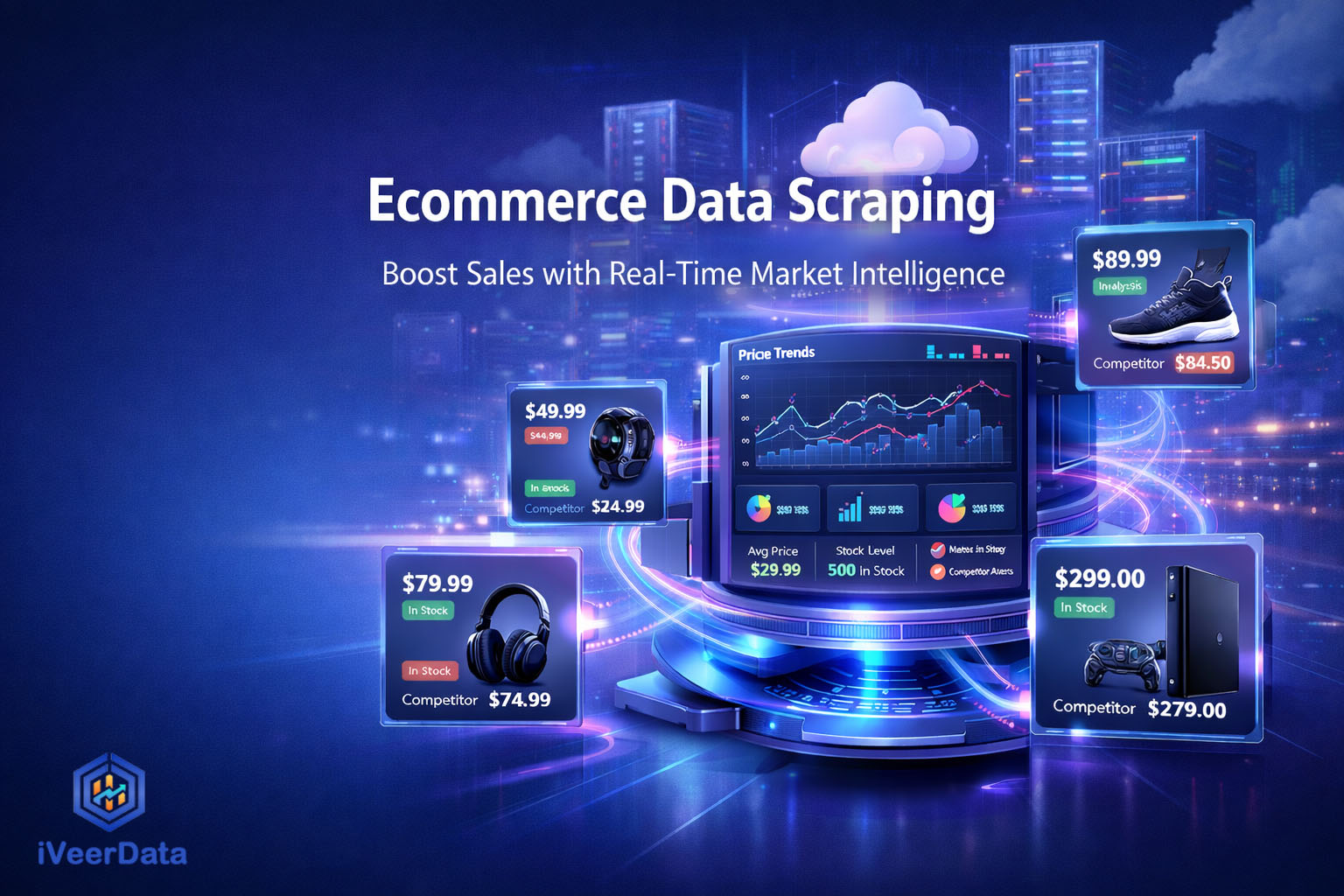
Ecommerce Data Scraping: Boost Sales with Real-Time Market Intelligence
The ecommerce industry moves fast. Prices change within hours. Products go out of stock without notice. New competitors enter the market every day.
If you're making pricing or inventory decisions based on outdated data, you're already behind.
This is where ecommerce data scraping becomes a game-changer.
By collecting real-time market intelligence from competitor websites, marketplaces, and retail platforms, businesses can make smarter decisions that directly impact revenue.
At iVeerData, we help ecommerce brands transform raw online data into structured, actionable insights that drive measurable growth.
What is Ecommerce Data Scraping?
Ecommerce data scraping is the automated process of extracting product, pricing, inventory, and customer-related data from online stores and marketplaces.
Instead of manually checking competitor websites, scraping tools collect data such as:
- Product prices
- Discounts and promotions
- Stock availability
- Customer reviews and ratings
- Product descriptions
- SKU-level details
- Marketplace seller information
The collected data is then structured into usable formats like CSV, API feeds, or dashboards.
Why Real-Time Market Intelligence Matters
Ecommerce is no longer static. It is dynamic and algorithm-driven.
1. Dynamic Pricing is the New Normal
Competitors adjust pricing multiple times a day. If you don’t track these changes in real time, you risk:
- Losing the buy box
- Reducing profit margins
- Missing flash sales trends
With automated scraping, pricing decisions become data-backed rather than guesswork.
2. Stock Monitoring Prevents Revenue Loss
If competitors go out of stock, it’s an opportunity.
If your product goes out of stock, it’s lost revenue.
Real-time inventory monitoring helps brands:
- Optimize replenishment cycles
- Adjust pricing when competitors run out
- Capture unmet demand
3. Competitor Intelligence Drives Strategy
Understanding competitor behavior helps businesses:
- Identify new product launches
- Track promotional campaigns
- Analyze pricing patterns
- Monitor MAP violations
Market intelligence provides clarity in a competitive landscape.
Key Use Cases of Ecommerce Data Scraping
Here are practical ways ecommerce brands use data scraping to boost sales:
✔ Competitive Price Monitoring
Track 50+ competitors simultaneously and adjust pricing dynamically.
✔ Marketplace Seller Tracking
Monitor Amazon, Walmart, Shopify, and other marketplace sellers to protect brand integrity.
✔ Review & Sentiment Analysis
Extract customer reviews to improve product positioning and identify pain points.
✔ Product Assortment Analysis
Understand gaps in your catalog compared to competitors.
✔ Demand Trend Monitoring
Identify trending SKUs before competitors do.
How Ecommerce Data Scraping Directly Boosts Sales
When implemented correctly, scraping leads to measurable business improvements:
- Higher conversion rates
- Better pricing accuracy
- Improved profit margins
- Faster response to market changes
- Reduced manual workload
Businesses that rely on outdated spreadsheets simply cannot compete with brands using automated intelligence systems.
Challenges in Ecommerce Data Scraping
While powerful, scraping requires expertise.
Common challenges include:
- IP blocking
- CAPTCHA systems
- Anti-bot protection
- Frequent website structure changes
- Data quality inconsistencies
This is why many ecommerce brands prefer professional scraping partners instead of in-house setups.
Why Businesses Choose iVeerData for Ecommerce Scraping
At iVeerData, we provide scalable, enterprise-grade ecommerce data extraction solutions designed for:
- High-frequency scraping
- Rotating proxy management
- Anti-block protection
- Clean structured datasets
- API delivery options
We ensure:
- Accuracy
- Compliance
- Scalability
- Real-time updates
Our goal is simple: turn competitive data into revenue opportunities.
The Future of Ecommerce is Data-Driven
Ecommerce is becoming increasingly automated and AI-powered.
Brands that rely on:
- Real-time intelligence
- Predictive analytics
- Automated price optimization
Will outperform those relying on manual monitoring.
Data is no longer optional — it is your competitive advantage.
Final Thoughts
If you are not actively monitoring competitor pricing, inventory, and marketplace behavior, you may already be losing sales without realizing it.
Ecommerce data scraping empowers businesses to move from reactive decision-making to proactive growth strategies.
The faster you access market intelligence, the faster you win.


