 "Revolutionizing Data Extraction, Unlock Hidden Data, Unlock New Possibilities"











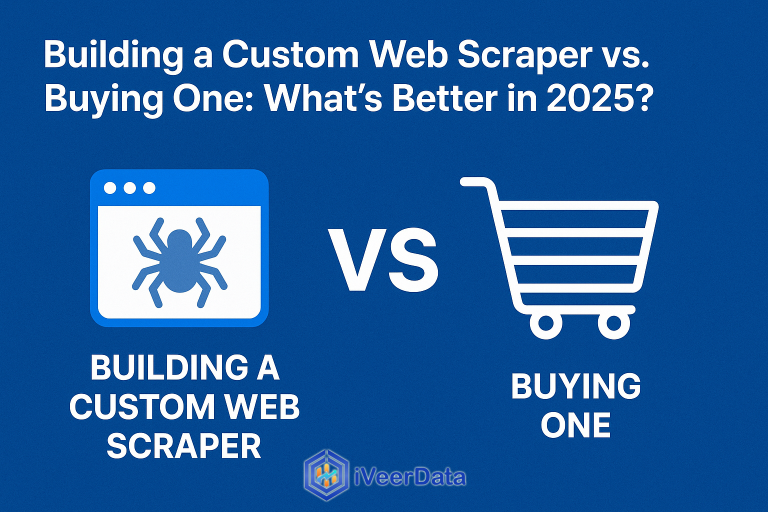
The demand for accurate, real-time data has exploded in 2025. Businesses across ecommerce, travel, retail, grocery, finance, OTT, real estate, and digital platforms now rely heavily on automated web scraping to power their decision-making. The question most companies face is whether they should build their own custom web scraper or buy a ready-to-use solution from a specialized provider like iVeerData.
Both approaches have advantages, but the right choice depends on scale, complexity, budget, and how fast you need results. This article breaks down the difference between building and buying web scraping systems, along with practical examples from industries already benefiting from modern data extraction.
What Does It Mean to Build a Custom Web Scraper in 2025?
Building your own scraper means creating an in-house infrastructure capable of extracting, cleaning, structuring, and delivering data consistently. This includes developing crawlers, handling rotating proxies, managing CAPTCHA challenges, monitoring changes in website layouts, and maintaining the pipeline.
While building a custom scraper gives full control, it also demands significant engineering expertise. Modern websites use dynamic content rendering, anti-bot frameworks, and API restrictions—making in-house scraping more difficult than ever.
What Does It Mean to Buy a Web Scraper?
Buying a scraping solution means relying on an external service provider for data extraction, maintenance, delivery, scaling, and compliance. Providers offer ready-made or fully customized solutions with infrastructure, proxies, monitoring, and APIs included.
This option gives businesses instant access to reliable datasets without heavy engineering investment. For industries like ecommerce, grocery, price intelligence, travel, real estate, news, and social monitoring, a purchasing model ensures faster deployment and better long-term stability.
Cost & Time Comparison
Building your own scraper generally requires hiring developers, data engineers, proxy providers, and maintenance teams. It means months of development, testing, and scaling before reliable data starts flowing.
Buying a scraper gives immediate access to production-ready pipelines. For example, businesses focused on ecommerce pricing can explore your ecommerce scraping service, while companies tracking grocery and food trends can use your grocery data extraction pages for fast implementation.
When time-to-market matters, buying is usually the more cost-efficient choice.
Maintenance and Reliability in 2025
Modern websites change frequently. Layout shifts, JavaScript rendering, new geo-blocks, and anti-bot updates can break a scraper instantly. Maintaining a stable scraper today is more complex than building one.
In industries like travel and hospitality, real estate, job sites, or news aggregation, stability is critical because data changes rapidly. Your existing hotel scraping, travel data, job scraping, real estate data pages, and news aggregation services highlight the kind of ongoing updates needed to keep pipelines running.
Buying a managed solution means the provider handles all these breakages and updates in real time.
Scaling Challenges
Custom scrapers often fail when asked to scale. Large datasets demand multiple IP pools, high-concurrency crawlers, automated retries, headless browser rendering, and load balancing. This infrastructure is expensive to build from scratch.
For businesses requiring heavy daily scraping—such as OTT watching-trend analysis, price intelligence, stock market data, SERP tracking, or mobile app scraping—scalability becomes a major factor. Your dedicated pages for these categories reflect industries that typically benefit more from buying than building.
Compliance & Ethical Scraping Responsibilities
2025 has stricter compliance requirements, particularly around user privacy, copyrighted data, and terms-of-service restrictions. Buying a scraper ensures compliance frameworks are already baked into the system.
This matters in sensitive areas like dark web scraping, promotion monitoring, store locator scraping, social media extraction, or brand monitoring. Providers like iVeerData already follow ethical guidelines and legal standards, reducing risk for clients.
Data Quality & Enrichment
A custom-built scraper extracts raw HTML, but transforming that into clean, ready-to-use datasets requires enrichment capabilities. These include normalization, deduplication, entity matching, and advanced preprocessing.
Businesses using market intelligence tools, analytics dashboards, or real-time scraping APIs need enriched data—not just raw values. This is another reason why buying a scraper is superior for any use case requiring structured, analysis-ready output.
Which Option Is Better for Your Business in 2025?
Building is best when businesses have very niche, proprietary needs, long-term budgets, and dedicated engineering teams. Companies looking for absolute control may still prefer custom solutions.
Buying is better for businesses that need reliability, compliance, speed, scale, and low maintenance costs. Most industries—ecommerce, grocery, travel, financial markets, OTT, promotions, brand monitoring, and SERP tracking—get better ROI by purchasing ready-made or custom-built services from professionals.
Conclusion: Build or Buy?
In 2025, buying a web scraping solution is the most efficient and reliable choice for most businesses. It delivers faster deployment, lower engineering costs, better compliance, and superior scalability. Building is viable only for highly specialized requirements and teams prepared to maintain complex infrastructure.
Whether a company needs price intelligence, market insights, travel data, real-time APIs, brand monitoring, social media signals, or OTT analytics, choosing a managed scraping provider ensures long-term stability and accuracy.


