 "Revolutionizing Data Extraction, Unlock Hidden Data, Unlock New Possibilities"











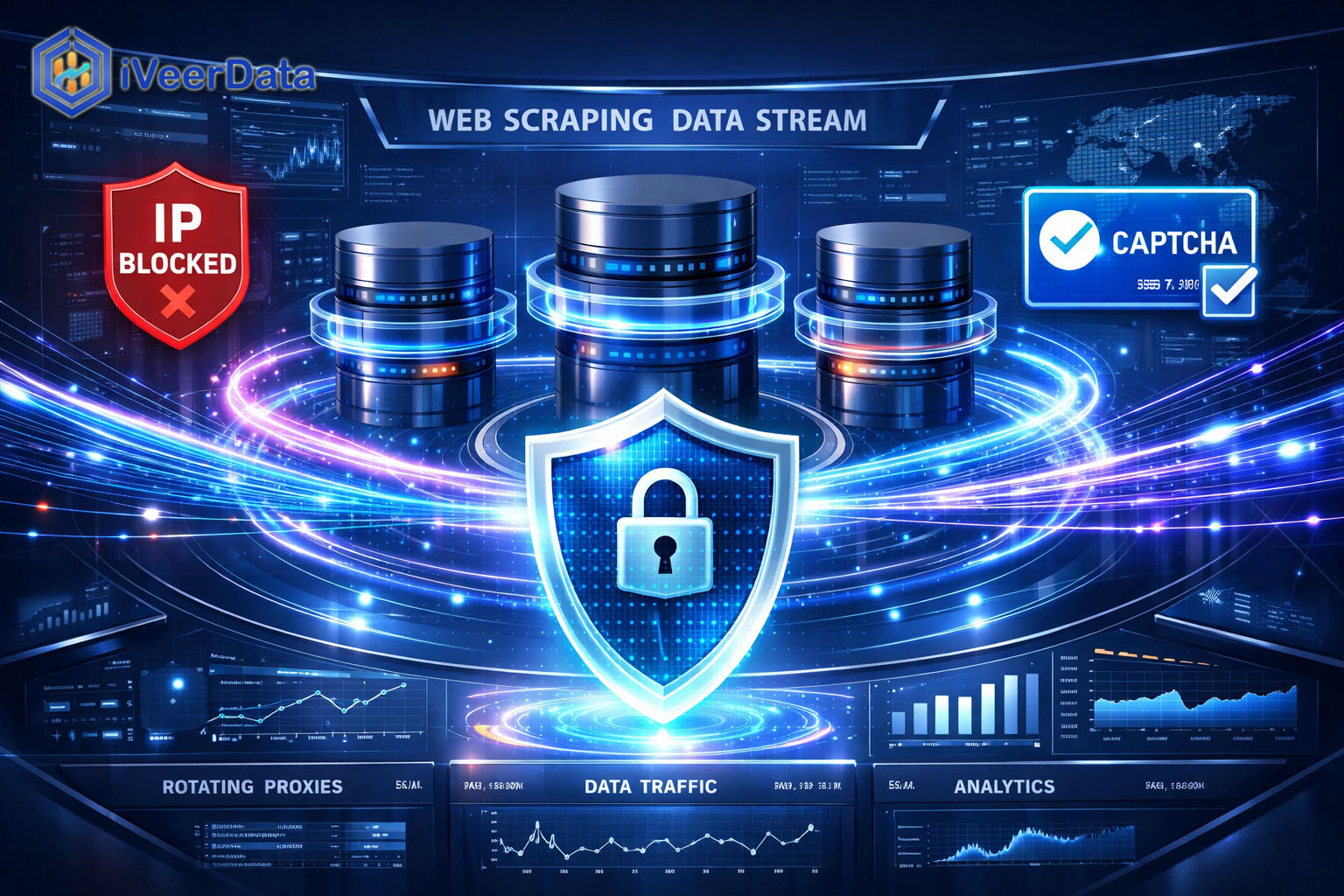
Web scraping is one of the most powerful tools for gathering competitive intelligence, ecommerce pricing insights, stock market data, and grocery monitoring information. However, one of the biggest challenges businesses face is getting blocked by target websites.
Modern websites use advanced anti-bot systems, IP tracking, browser fingerprinting, and behavioral analysis to detect automated traffic.
At iVeerData, we help businesses build scalable and anti-detection web scraping infrastructures that ensure uninterrupted data extraction.
In this guide, you’ll learn 10 proven strategies to avoid getting blocked while web scraping in 2026.
Why Websites Block Web Scrapers
Before preventing blocks, you need to understand why they happen.
Websites block scraping activity to:
- Prevent server overload
- Protect proprietary data
- Stop competitive monitoring
- Reduce spam and bot attacks
Common blocking methods include:
- IP bans
- 403 Forbidden errors
- 429 Too Many Requests
- CAPTCHA challenges
- JavaScript fingerprinting
Understanding these defenses is the first step toward building a smart scraping strategy.
1. Use Rotating Proxies
Sending repeated requests from a single IP address is the fastest way to get blocked.
Best Practices for Proxy Rotation
- Use residential proxies for higher trust scores
- Rotate IPs after a fixed number of requests
- Distribute traffic across multiple geographic locations
- Avoid reusing flagged IP addresses
Residential proxies mimic real user traffic, making detection far less likely.
2. Implement Smart Rate Limiting
High-frequency requests signal bot behavior.
How to Mimic Human Browsing
- Add random delays between requests
- Avoid scraping thousands of pages per minute
- Introduce natural pause intervals
- Respect server response times
Smart scraping is controlled scraping.
3. Rotate User Agents
If every request uses the same user agent string, websites will detect automation.
What You Should Do
- Rotate modern browser user agents
- Match user agents with proxy geography
- Update user agents regularly
This makes requests look like they’re coming from real browsers.
4. Use Headless Browsers When Necessary
Some websites rely heavily on JavaScript rendering.
When to Use Headless Browsers
- Dynamic ecommerce websites
- SPA (Single Page Applications)
- Platforms using heavy JS rendering
Tools like headless browsers simulate real browsing behavior and reduce detection risk. However, use them strategically since they require more resources.
5. Maintain Proper Session & Cookie Handling
Websites track user sessions using cookies.
If your scraper starts a new session every time, it appears suspicious.
Session Management Tips
- Store cookies between requests
- Reuse active sessions
- Avoid clearing cookies unnecessarily
- Maintain browsing consistency
Session continuity improves trust scores significantly.
6. Avoid Predictable Scraping Patterns
Bots behave in predictable sequences.
Add Randomization
- Vary navigation paths
- Change time intervals
- Shuffle page order
- Simulate scrolling behavior
Human unpredictability reduces detection chances.
7. Monitor HTTP Status Codes in Real Time
Blocking usually starts with warning signs.
Warning Signals
- 403 Forbidden
- 429 Too Many Requests
- Unexpected redirects
- Increased CAPTCHA frequency
Implement automatic backoff and retry mechanisms to prevent permanent bans.
8. Handle CAPTCHA Strategically
CAPTCHAs are often triggered by suspicious activity.
Instead of aggressively solving them:
- Reduce request speed
- Improve proxy quality
- Improve behavioral simulation
Prevention is more effective than solving.
9. Respect Legal & Ethical Boundaries
Scraping publicly available data is often legal, but compliance matters.
Best Compliance Practices
- Review website terms of service
- Avoid private or login-protected data
- Focus on public business information
- Consult legal guidance for sensitive industries
At iVeerData, ethical scraping is a core operational principle.
10. Use a Professional Web Scraping Infrastructure
Large-scale scraping requires:
- Proxy pool management
- Cloud-based distributed systems
- Anti-detection engineering
- Continuous monitoring
Building this in-house can be expensive and technically complex.
That’s why many enterprises partner with professional web scraping providers like iVeerData to ensure:
- 99% data accuracy
- Scalable infrastructure
- Minimal blocking issues
- Compliance-focused extraction
Common Mistakes That Lead to IP Bans
Avoid these errors:
- Scraping too fast
- Using free proxies
- Ignoring status codes
- Repeating failed requests
- Using outdated user agents
- No rotation strategy
These mistakes trigger automated blocking systems quickly.
Why Anti-Blocking Strategy Is Critical for Businesses
If you rely on scraping for:
- Ecommerce price monitoring
- Grocery competitor tracking
- Stock market data collection
- Sports betting odds scraping
- Social media monitoring
Getting blocked means:
Lost data → Lost insights → Lost revenue.
A well-designed anti-detection strategy ensures business continuity.
Final Thoughts
Avoiding blocks while web scraping is not about bypassing systems aggressively — it’s about:
- Mimicking human behavior
- Distributing traffic intelligently
- Respecting rate limits
- Using professional infrastructure
Businesses that treat scraping as a structured data engineering process achieve long-term success.
Need Reliable, Scalable Web Scraping?
If you’re looking for enterprise-grade, anti-detection web scraping services, iVeerData provides secure, scalable, and compliant data extraction solutions across ecommerce, grocery, finance, betting, and social media industries.
📩 Contact: sales@iveerdata.com


